HTML to WordPress Elementor Development
HTML to WordPress Elementor development for businesses and agencies that need editable content while keeping an approved design. I rebuild ordinary headings, images, buttons and layout sections as native Elementor elements, with scoped CSS or JavaScript only where an interaction needs it.
Editable content rather than a pasted document
A whole-page HTML widget can leave normal content outside the visual editing workflow. This service maps headings, paragraphs, images, lists and buttons into native elements. Repeated patterns become reusable sections where appropriate.
Source review
- HTML structure, stylesheets, scripts and asset paths.
- Routes, navigation and anchor links.
- Responsive rules, image crops and interaction states.
- Form actions, validation and external APIs.
- Metadata, heading structure and canonicals.
Deliverables and process
Share the source folder or a live reference you own or are authorized to reproduce. I inventory the pages and dependencies, map content into native widgets, rebuild the approved layouts and compare them across screen sizes. Handover identifies scripts and integrations that still need maintenance.
If Claude or another AI tool produced HTML, CSS and JavaScript, share those actual files and the intended behavior. React components need a component-level review. A public URL or screenshot guides visual reconstruction; it does not expose private code, application data or API permissions. Those workstreams are scoped separately.
CSS and JavaScript need adaptation
Styles written for the old markup can conflict with WordPress or Elementor. The aim is to preserve the result while fitting the new structure. JavaScript is retained or rewritten only for agreed behavior. Private processing code cannot be inferred from a live page alone.
Forms require a delivery test
A visible form is not proof that email arrives. Its processing service must be identified or replaced with an agreed solution, then tested. A static cart is similarly not a working checkout. Visual reconstruction and backend functionality are reviewed separately.
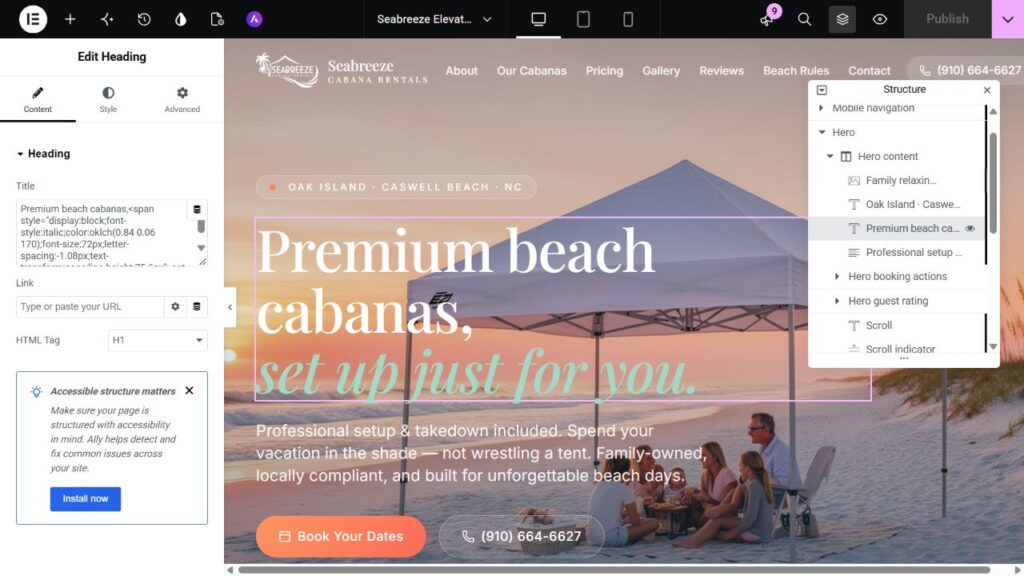
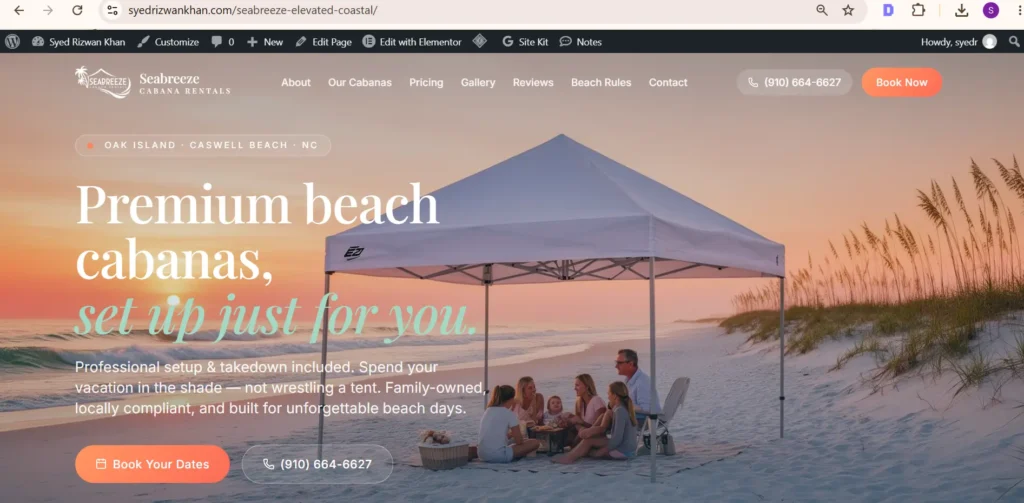
The Seabreeze images below show native Elementor editing from a React/Lovable demonstration. They illustrate the editing workflow, not a separate HTML-source project.
HTML example brief: a small licensed HTML/CSS page, its native widget mapping, source/build captures at matching desktop and mobile widths, and tests of a longer heading, replacement image and functional form. A dedicated paired HTML example is not published yet.
HTML conversion questions
Can normal content remain editable without an HTML widget?
Yes. Native widgets handle ordinary visible content. Small isolated scripts may still support custom interactions.
Can you work from a live URL?
Yes, with permission to reproduce the site. Source files clarify hidden functionality and asset dependencies.
Will existing URLs change?
They should be preserved where practical. Any changed route needs a relevant redirect plan before launch.
Can you preserve the current design?
That is the implementation brief. Source assets, licensed fonts, responsive behavior and interaction states are reviewed before a matching target is agreed. A rebuild is tested at agreed widths; a converter export alone is not acceptance.
Choose the right service
See Figma implementation for design files or React conversion for component-based frontends. Send the reference through the project inquiry section.
Have a design you need built?
Send the live HTML website or a view-only source folder, required routes and scripts, asset permissions and form destinations. I will confirm what stays native, what needs support code, and the page and revision scope. Hosting, licenses and external integrations are identified separately.